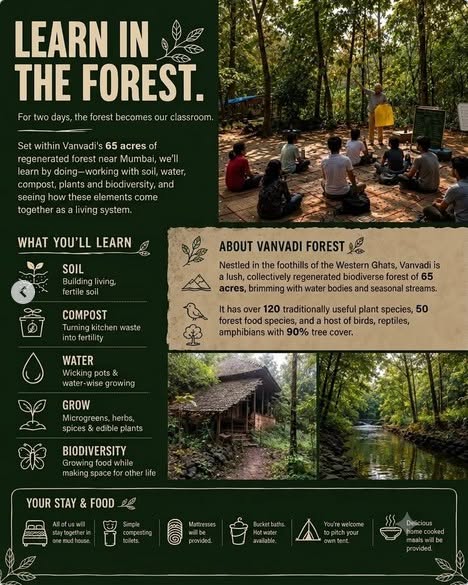
Learn in the forest for two days. Vanvadi’s 65 acres of regenerated forest near Mumbai host the session. We learn by doing—soil, water, compost, plants, and biodiversity. We observe how these elements form a living system.
What You’ll Learn
Soil: Building living, fertile soil
Compost: Turning kitchen waste into fertility
Water: Wicking pots & water-wise growing
Grow: Microgreens, herbs, spices & edible plants
Biodiversity: Growing food while making space for other life
Stay & Food
Simple composting toilets, mattresses provided, bucket baths with hot water available, or you can pitch your own tent. Delicious home-cooked vegetarian meals provided.
Please go through this information carefully and fill out the form above to register:
About the Workshop
Who is this workshop for?
We are looking for people who want to build and nurture tiny edible urban jungles for themselves and local biodiversity.
Do you live in an urban or semi-urban setting and feel the intolerable void of being disconnected from nature? Do you have a balcony, a terrace, a small backyard, or even a windowsill where you hope to nurture a tiny jungle? Does the idea of growing your own food pique your wonder? Do you ponder on how you can live more sustainably and closer to nature?
If your answer is yes to any of these questions, then this workshop is probably for you.
You need no prior experience, and people of all ages are welcome.
When & Where
Step away from your screens and join us for a weekend workshop, October 10 & 11 at the Vanvadi Forest, Vare (near Mumbai).
Participants are welcome to arrive on Friday, Oct 9 and leave by Monday, Oct 12 at 11:00 AM at no extra cost to enjoy the bounties of Vanvadi.
What You Will Do
Spend 2 days in a forest, with the forest as our classroom and teacher:
Learn about nurturing living soil and understand how to work with water, sunlight, plants, and other biodiversity in urban spaces.
Make compost, self-watering wicking pots, and microgreen trays, and get hands-on time potting and learning essential skills for your kitchen and garden.
Immerse yourself in the forest and natural cycles, and learn to apply the principles of the interconnectedness of life for a more sustainable urban life and garden.
Volunteer Co-Instructors
Elijah De Souza (he/him)
Elijah is an organic farmer, nature educator, maker, and garden landscape consultant. He picks up close to 100 kg of wet waste from restaurants in Anjuna and recycles it on his pig farm. He cares for 20 hens, quails, and stray cows, and grows various vegetables, fruits, and spices in his carefully preserved ancestral land. He researches and prototypes solutions for small spaces at the intersection of older natural farming techniques and modern technology. He has a BSc in Agriculture and is an amazing vermicompost producer. He is an environmental and land rights activist in Goa, teaches farming in schools, and conducts weekend workshops for adults. He also runs a library and delivers books on a bicycle to his subscribers!
Inchara is a regenerative farmer, entrepreneur, artist, maker, environmental activist, aspiring naturalist, and designer of balcony jungles, urban homes, and experiences. She has a BSc in Biotechnology, Chemistry, and Botany, and is a nerd about soil biology and the edible landscapes of the Western Ghats (where she is from). She has spent 7 years designing biodiverse edible balcony jungles and prototyping techniques and strategies for a busy urban life. She currently runs Earth Connect (a forest conservation expeditions company), Curioso Goa (a hospitality and experiences company), and Alternate Living (a design company to make urban homes more sustainable and regenerative).
Vanvadi is a collectively regenerated forest of 65 acres at the foothills of the Sahyadris in the Western Ghats. It was started in 1994 by a group of over 12 people as an experiment in caring for the land without aiming for any commercial speculative gain. Once a clear-felled piece of land, it is now a thriving forest with 90% tree cover, brimming with seasonal streams, rock pools, more than 120 traditionally useful plant species, over 50 forest food species, and a host of birds, reptiles, amphibians, arachnids, crabs, and more. It is operated with the help of local Adivasi communities using principles designed to fit into local natural and cultural ecosystems.
Vanvadi houses two community homes where it hosts various workshops and events of ecological and educational value in collaboration with local and non-local experts and instructors. It is an “ecoversity” and learning alliance—and a community where people can collaboratively live and learn, supporting each other in symbiotic harmony, just like the forest around us!
Cost
Includes food, accommodation, and all workshop-related expenses.
We follow a “pay what you can afford” model. You can choose to pay as per one of the options below to book a seat:
INR 2,000 – Need-based Scholarship Seat
INR 3,500 – General Seat
INR 5,000 – General Seat + contributions to ecological and educational activities of Vanvadi
If for any reason you are not able to afford these fees, WhatsApp us with a request for a full scholarship.
Date & Timing
Starts: Saturday, October 10 at 10:30 AM
Ends: Sunday, October 11 at 5:30 PM
The forest is beautiful at this time of the year—there are paths, streams, sounds, trees, birds, creatures, silence, and a community of like-minded people waiting to be met.
Location & Travel
Vanvadi Forest, near Chichwadi and Vare Village (2 hours from Mumbai), Maharashtra 410101 Google Map Location:Vanvadi Forest
About 95 km from Mumbai and 9 km from the Neral train station of Matheran fame. There are also 3 carpooling seats available for those coming from Goa (departure on early morning Oct 9 and reaching back on Oct 12).
How to Get There
Train: The nearest railway station is Neral (of Matheran fame) on Central Railway; all Karjat/Khopoli-bound local trains from Mumbai stop here. Exit from the extreme rear end of the platform (closer to Mumbai) and walk 5 minutes toward the Neral bus stand. Just before the bus stand, find the parking lot for auto drivers from Devpada village (numbers will be shared). They know Vanvadi well and will charge Rs 250–300 to bring you (max 4 people) straight to the Vanvadi community house.
Car: 95 km from Mumbai. Parking is available at the venue.
Nearest Airport: Mumbai
Food & Accommodation
You will be housed in two beautiful mud homes, open on two sides to the forest. Expect a safe, basic, and beautifully whimsical stay. It will be intermittently wet and chilly at night, so carry light warm jackets, a sleeping bag (if you have one) or a blanket, and 2 sheets for the nights. Mats and mattresses will be provided, but there are only a few cots available for seniors. You are also welcome to pitch your own tent if you prefer privacy.
The facilities are basic: composting toilets and bucket baths in a shared, closed bathroom with hot water available.
Delicious local vegetarian food (breakfast, lunch, dinner, and tea for the entire duration of your stay) will be prepared by the local Adivasi community in our community kitchen.
Note: The classroom space is the same area used for sleeping at night. Managing this transition each morning and evening will require the involvement and goodwill of the people sleeping there.
We strongly encourage the use of ecological, non-chemical products and urge you to avoid using plastics, chemical soaps, detergents, toothpaste, etc.
What to Bring
Photos, dimensions, and North/South directions of balconies or spaces where you intend to grow plants.
Bedsheet (to sleep on for a single mattress), light blanket, light jacket for the night, towel, non-industrial/chemical-free hygiene products, torch/headlamp, rain protection gear, good shoes/sandals for hiking, chappals, and clothes.
Your preferred sleeping bag or tent if you want privacy.
Any musical instrument you play!
Comfortable swimwear (an additional towel is advisable). There are streams and pools for expert swimmers.
Natural bug protection sprays/roll-ons.
Any plastics or non-degradable items you bring should be carried back with you. We discourage manufactured food items, but homemade snacks or items supporting local communities are welcome.