We had planned a two-day expedition to cover Mulher, Mora, and Hargad. Our intention was to camp overnight at Mulher, and to facilitate this, we arrived at Mulher on Saturday morning.
There were five of us in the group: myself, Nilesh Bathe, Atharva Bhatkar, Nikhil Guhagarkar, and Dhundiraj Shirke.
We began our trek in the morning and set off towards Hargad. We finished exploring Hargad amidst the scorching afternoon heat, and around 4:00 PM, we started our ascent to Mulher from the saddle situated between Hargad and Mulher.
The plan was to reach the summit of Mulher by sunset and enjoy the view of the setting sun from there. We intended to pitch our tents on Mulher Fort, spend the night there, and then trek to Mora the following morning before making our descent.
By 5:00 or 5:15 PM, we reached the spot on Mulher Fort where the sculpture of Lord Maruti is located.
We paid our respects to the Maruti idol; since our water supply was running low, Nikhil went over to a water cistern situated right next to the sculpture.
Upon peering into the cistern, we discovered that a monkey had fallen inside—and it was dead. It appeared to have fallen in quite recently—perhaps just today or yesterday—and had died very recently, as the decomposition odor had not yet begun to set in. Consequently, Nikhil and Dhundiraj decided to retrieve the monkey from the cistern to prevent the water from becoming contaminated and to ensure the animal’s remains did not rot inside.
It took the pair roughly fifteen to twenty minutes of strenuous effort to extract the monkey from the cistern; they spent that entire time working right at the base of the tank. Finally, they managed to pull the monkey out, buried it in a spot right next to the cistern, and were just about to move on.
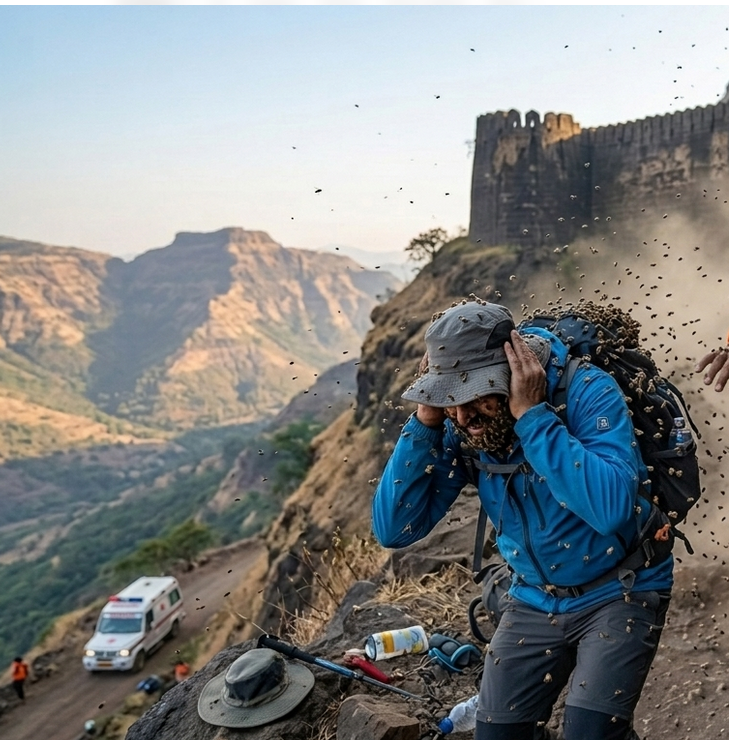
Dhundiraj had descended a short distance, while Nikhil was climbing down right behind him. Dhundiraj reached us, and as we turned to look back, we heard a shout coming from behind Nikhil. He was situated on a small rocky ledge beneath the tank—a distinct rock patch—lying prone, while above him swirled a terrifying storm of honeybees.
Within just a few minutes, he had been stung by a great number of them; he lay there motionless, his head bowed. We were positioned roughly two minutes away from him. Since our backpacks contained sheets and blankets intended for our overnight stay, we quickly pulled them out.
The swarm of bees around Nikhil was intensifying rapidly, and they were relentlessly stinging him from every direction. We all had sheets at our disposal, but the immediate and critical challenge was getting one of those sheets to Nikhil. His condition had deteriorated drastically; the bees were attacking him with ferocious intensity, and no one dared to approach him. Finally, Dhundiraj mustered the courage to throw a sheet toward Nikhil. Nikhil, trapped in a precarious spot, somehow managed to pull the sheet over his head; however, it proved slightly insufficient. Because he was still wearing his backpack, the sheet could not completely cover his body. Moreover, his physical state at that moment made it impossible for him to remove the backpack. Nevertheless, even in that dire situation, he struggled to pull the sheet tighter; having suffered so many stings, his body was going numb, and he was too disoriented to think clearly. Despite this, he managed to drape the sheet over himself, but because it did not provide full coverage, bees continued to swarm and sting him from the exposed sides and underneath.
Meanwhile, the four of us had managed to fully cover and protect ourselves; yet, right before our eyes, Nikhil remained trapped in a perilous position—engulfed by that swirling vortex of bees. The situation had become truly dire.
Just then, Nikhil attempted to climb down; he slipped slightly and tumbled to the ground below. Fortunately, it was a small patch of rock, and he managed to get stuck right there; had he slid any further down from that spot, he would have plummeted a considerable distance.
Nikhil tried to steady himself a little and wrapped the sheet tightly around his body. By now, the flies had begun to drift over toward our side. It seemed inevitable that all five of us were about to face a full-blown attack by the flies.
I don’t know what suddenly came over me, but I decided that at least one of us had to get out of there immediately. I simply pulled whatever clothing I had on even tighter around myself, told the others, “I’m heading down,” and instructed them to remain seated right where they were, exactly as they were.
The moment I stood up and started walking, two flies bit me fiercely—one on my hand and another on my head.
I decided to keep running forward, aiming for the mountain pass ahead. I kept moving forward, but having been utterly exhausted by the day-long trek, this sudden attack left me feeling even more wretched and distressed.
I continued walking until I reached a safe spot further ahead; once there, I immediately pulled out my mobile phone and called Atharva, who was still up on the slope. Luckily, his call went through—I had tried calling the other two guys first, but both of their phones were switched off. I asked Atharva about the situation up there, and he replied, “The three of us have managed to cover ourselves up, but there are swarms of flies all over Nikhil, and they are still biting him relentlessly.”
I then began to ponder what could be done to help. Given the circumstances, there wasn’t much I could do personally from where I was, so I decided that our best course of action was to contact a rescue team—darkness was beginning to fall, and Nikhil’s condition was deteriorating rapidly. So, I tried reaching out to some prominent figures in the Sahyadri region, but I received no response from them. Finally, I called some contacts I had in the village of Mulher; however, even they did not initially provide the kind of response I was hoping for.
I happened to have the contact number of Dayanand Koli—or ‘Dada’—from Nashik; I gave him a call, and the very first thing he did was reassure me. He told me to calm down and clearly explain exactly what the situation was.
I explained the situation to him: that while everyone else—aside from Nikhil—was doing fine, I had already made my way down.
He then gave me the contact number for Bhavdas Pawar *Dada* from Salherwadi and placed a call to him as well.
I phoned Bhavdas *Dada* in Salherwadi, and he replied, “I just finished speaking with Sir. It’s about 22 kilometers for us to get there from here; I don’t have a vehicle available right now, nor do I have anyone with me. I’ll make immediate arrangements and set out.” However, I realized it would still take him at least 45 minutes to an hour to reach us.
I was left wondering what to do in such a predicament when Dayanand Sir called again. He said, “I’ve sent you Rohit Jadhav’s number; give him a call.” I slapped my forehead in frustration, thinking, “How on earth did I fail to remember Rohit *Dada’s* name while I was right here in Baglan?”
I immediately called Rohit *Dada* and explained the situation to him. Rohit *Dada* reassured me, saying, “Don’t worry about a thing; just stay calm. Try to make your way down to the Ganpati Temple in Mulher, and I will coordinate the necessary assistance.”
I started my descent, but all my water was still in the bag I had left up top. My throat had gone completely dry—I could barely even utter a word.
As I headed toward the temple, I kept receiving calls from both Dayanand Sir and Rohit *Dada*. Rohit *Dada* had contacted several people in the village, and a group of young men had set out to help. I was receiving calls from them as well, guiding them on our exact location and status, while simultaneously trying to maintain contact with Atharva, who was still up on the mountain.
Each time I managed to get through to them on the phone, it gave them a renewed sense of hope and reassurance—for up there, they were completely at a loss as to what to do next. I gave them just one instruction for the time being: “Stay seated exactly where you are; keep encouraging and reassuring Nikhil. If he feels up to it, tell him to take a sip of water. The dizziness should pass shortly.”
I was calling Atharva every ten minutes to update him on the situation. Help from the village was already on its way up, but the swarm of bees surrounding Nikhil showed no signs of diminishing; they continued to sting him relentlessly. Nikhil made one last effort, causing him to slip a little further down. He was now in such a precarious position that if he attempted to move even slightly, he would slide straight down into the abyss below. Consequently, he had no choice but to remain seated exactly where he was; his situation was becoming increasingly dire.
All the strength in his body was draining away; the incessant bee stings had left him completely drained of vitality.
I reached the temple and spoke with Dayanand Dada and Rohit Dada. They reassured me, saying, “Don’t worry about a thing; we have already made all the necessary preparations.”
Meanwhile, I was constantly receiving calls from the rescue team stationed below. I kept updating them on the situation, and they, in turn, offered words of encouragement, assuring me that they were on their way.
By now, darkness had enveloped the entire area. More than an hour had elapsed since the ordeal began.
Just as I reached the temple, a group of five young men from the village—led by Rohidas Pawar—arrived from below. They had brought along essential supplies, including bottles of water and ORS. I gave them the exact location of where Nikhil was stranded. I started to accompany them, but they wouldn’t let me; they insisted, “You stay right here and don’t worry—we’ll handle everything from here on out.”
They handed me some water and supplies; I stayed put, while they began their ascent.
I called Atharva to let him know that the rescue party had set out from my location and would reach them shortly. When I asked about the situation up there, Atharva replied, “The bees near us have dispersed, but Nikhil is still surrounded by them.” I told him to keep talking to Nikhil but advised against asking him to move, as any sudden movement could cause him to fall. I also suggested trying to give him plenty of water—especially since they had ORS on hand—but no one could actually reach him due to the swarm of bees hovering nearby. Furthermore, he was stranded in a treacherous spot, making it impossible for anyone to simply walk straight up to him; indeed, had anyone attempted to approach, the bees would have attacked them as well.
Meanwhile, Rohit Dada was calling every ten minutes to get updates, and I was keeping him fully informed of the unfolding situation.
By the time the group of boys coming up from below finally reached Nikhil, the bees that had been swarming around him had completely vanished. When the boys arrived at the spot, it was already pitch black all around.
Sitting alone in the darkness near the Mulher Fort entrance, I suddenly heard the distinct calls of a leopard echoing from the forest below.
At that moment, my instincts kicked in immediately. Rohit Dada had already warned me beforehand: “Under no circumstances are you to descend alone from there. I will make all the necessary arrangements down below; you just stay put right where you are, as this forest is home to wild animals.”
As I sat waiting near the entrance, I began receiving calls from numerous Forest Department officials; Rohit Dada had already alerted everyone—the police station, the Forest Department, and all other relevant authorities—about the critical situation.
I was fielding calls from many Forest Department personnel asking for my exact location so they could come to my aid; meanwhile, a large number of villagers had also set out to reach the site.
By that time, Rohit Dada had also arranged for Sonu Ghatmal Dada’s vehicle to be brought up from the village and stationed right at the very base of the fort.
Additionally, he had ensured that the doctors at the government hospital in the village were on standby and fully prepared to receive us. The situation at that point was one of complete darkness. Amidst these conditions, they managed to reach Nikhil. Subsequently, three individuals from the group took charge of him—as Nikhil was in absolutely no condition to walk—while the remaining two members took our bags. We then sent our three companions ahead, and the three of us who remained behind began the trek, taking turns carrying Nikhil on our backs.
The path was extremely rugged and slippery, and the darkness had become truly ominous.
The light from our flashlights was our only lifeline. Taking turns, they carried Nikhil down on their backs. Meanwhile, some personnel dispatched by the Forest Department reached me at the entrance gate.
I called up to inquire about their progress, and they replied that there was no need for anyone else to ascend, as they had already descended nearly halfway; therefore, I should take whoever was with me and head down.
So, I set off from there with my group toward the vehicle, while continuously receiving updates from those above. We reached the car just as the beams from the descending group’s flashlights became visible to us—a sight that brought a wave of relief to our anxious hearts. Upon our arrival, we found that the group from Salherwadi—who had set out earlier—had also reached the spot.
Amidst all this commotion, I had completely forgotten to call the Salher group to inform them that help had already reached us and that they need not come any further; yet, they had arrived regardless, bringing along plenty of water bottles and yogurt to assist us. A significant number of Forest Department personnel had also begun to gather at the location.
Sonu Dada was seated inside his vehicle nearby; when I approached him, he explained that he had remained inside the car because he could hear the sounds of a leopard in the vicinity.
His vehicle was fully prepped and ready to go. From that point onward, Sonu Dada took complete charge of the situation.
He immediately phoned the doctors and instructed them to be fully prepared and on standby at the hospital.
As for the group from Salher, they insisted that they would ascend the trail under any circumstances, reasoning that those carrying Nikhil down must be exhausted and in need of assistance. They started heading upward, but before they could go very far, the entire group descending from above reached the bottom.
They had managed to bring Nikhil down by carrying him on their backs—taking turns one after another—until they reached the base.
The moment they arrived at the bottom, Sonu Dada had the vehicle ready to depart without a moment’s delay. Nikhil started the car, helped his accompanying colleagues get inside, and immediately rushed them to the government hospital.
At the hospital, Dr. More was fully prepared. The moment they arrived, the doctor assessed the situation and immediately commenced treatment.
The doctor promptly administered an IV drip and reassured us, saying that the situation was now completely stable and that we need not worry anymore.
Subsequently, we thanked everyone who had gathered outside to offer assistance; we met with each individual personally and expressed our gratitude to them.
And then, we asked them all to head home.
The situation was now under control, so we, too, felt relieved. Consequently, everyone had some water and simply sat right there at the hospital.
The doctors informed us that the treatment would take another hour and a half or so, and suggested that we arrange for a meal in the meantime. So, we set out to get food; we also needed to pick up packed meals for the two people who had remained behind at the hospital. There was no mobile network coverage at the hospital, yet Rohit Dada kept trying to call us continuously.
Due to the lack of network connectivity, our phones simply wouldn’t ring through. The moment we reached the hotel, Rohit Dada’s call came through; we informed him that the situation was completely under control and explained our current whereabouts.
Dayanand Dada had also made several attempts to reach us. We called him back as well to update him on the situation and express our gratitude.
After picking up the packed meals, we returned to the hospital, only to find that the treatment was by then nearing completion.
The doctors asked Nikhil to walk around a bit and encouraged him to eat something.
After he had eaten, Nikhil felt a renewed surge of energy. However, we had no arrangements made for an overnight stay anywhere else. Since we had our tents and camping gear with us, we decided we needed to find a place to camp for the night. We asked the doctors if we could keep Nikhil at the hospital, but they replied that there was no need for that.
So, we decided to take Nikhil along with us to our campsite. We got back in touch with Rohit Dada, who suggested we head to the Mulher Math (monastery), assuring us that he would inform Sunil Dada to expect us. At around 11:00 PM, Sunil Dada opened the gates of the Mulher Math for us, and we finally settled down to sleep inside the monastery.
Thus, in the Sahyadris, one can never predict when or what kind of challenging situation might arise. We have been trekking through the Sahyadris for nearly 12 or 13 years now, yet we had never faced a situation quite like this until today. And, in principle, we were prepared for such eventualities.
However, this particular crisis struck at such an inopportune moment—one where we didn’t even get the slightest opportunity to react or make any proactive moves. Amidst all of this, the assistance provided by Dayanand Dada and Rohit Dada was truly beyond words.
Many residents from Mulher village had gathered there to lend us a helping hand; people from Salherwadi, too, had arrived to offer their support.
Baglan has always been a subject of deep affection for me, but this experience—combined with the inherent nature of the people of Baglan—has only deepened my love for the region even further.
Nitesh Ranpise (originally in marathi via whatsapp)
https://www.threads.com/@bhatkya_baba
https://www.facebook.com/nitesh.ranpise/